Buying CBD can be confusing. One bottle may cost $30, another may cost $100, and both can claim to be “premium.” So how can you tell if CBD is actually high quality?
Start with what you can verify. Look for clear labeling, third-party lab testing, a Certificate of Analysis (COA), the amount of CBD in the product, the type of CBD being used, and a company that tells you what is actually inside the bottle. Price alone does not prove quality. Neither does a fancy label or a long list of health claims.
I’ve been involved with CBD products since 2019, and one thing I’ve learned is that consumers need a simple way to separate marketing from information they can actually check. Here is what I look for.
The Quick Answer
High-quality CBD should have clear product information and lab results that help confirm what is actually in the product. Look for the amount of CBD, the type of CBD, ingredient information, batch testing, and a Certificate of Analysis. A trustworthy company should make it reasonably easy for customers to understand what they are buying.
That’s the quick answer. But there are several things worth checking before you spend your money.
1. Look for a Certificate of Analysis
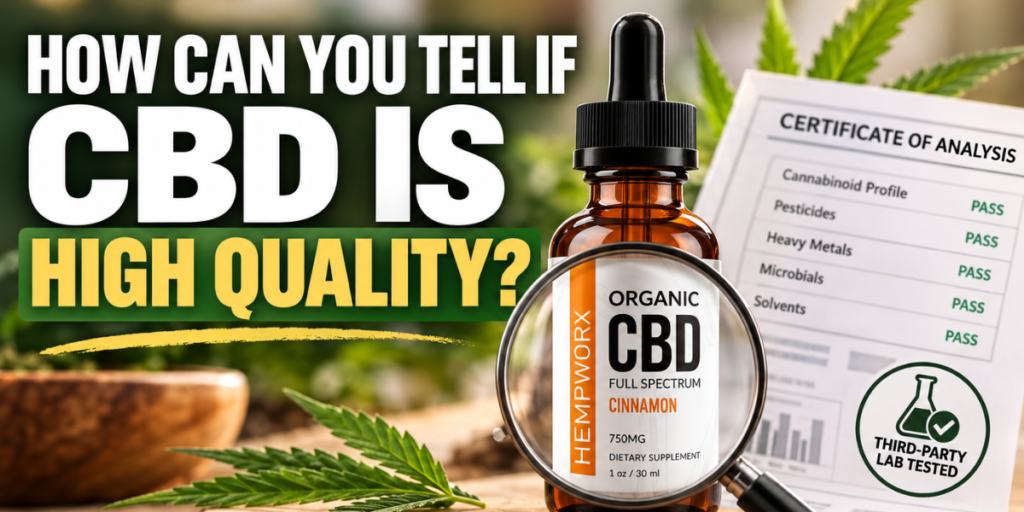
One of the first things I look for is a Certificate of Analysis, usually called a COA. A COA is a laboratory report showing information about a CBD product or tested sample. Depending on the testing performed, it can show the cannabinoid profile and results for things such as THC and certain contaminants.
Why does that matter? You shouldn’t have to rely only on what the front of the bottle says. The FDA has raised concerns about the quality of CBD products and has found products that did not contain the levels of CBD they claimed. It has also investigated concerns about contaminants such as pesticides, heavy metals, and THC. That makes testing an important part of evaluating a CBD product.
When looking at a COA, check whether the information appears to match the product you are buying. Look for identifying information such as the product name and the batch or lot number, when provided. A COA shouldn’t just be something a company mentions in its advertising. It should give you useful information.
2. Check How Much CBD You’re Actually Getting
Don’t judge a CBD product by the size of the bottle. A larger bottle doesn’t automatically mean more CBD.
Look for the amount of CBD listed in milligrams, usually written as “mg.” Then look at the serving information so you understand how much the product provides per serving. For example, two bottles could both contain one fluid ounce of liquid while containing different amounts of CBD. That’s why comparing bottle size alone can be misleading.
This also matters when comparing prices. A cheaper bottle isn’t necessarily a better deal if it contains much less CBD. On the other hand, the most expensive product isn’t automatically the best. You need to know what you’re actually paying for.
3. Know What Type of CBD You’re Buying
You’ll commonly see CBD products described as full-spectrum, broad-spectrum, or CBD isolate. Those terms are not interchangeable.
Full-spectrum CBD generally contains CBD along with other naturally occurring hemp compounds and may contain THC within applicable limits.
Broad-spectrum CBD generally contains multiple hemp compounds while being processed to remove THC or reduce it to non-detectable levels, depending on the product and testing.
CBD isolate is a more purified form of CBD, separated from many of the other hemp compounds.
One isn’t automatically “high quality” simply because it is full-spectrum, broad-spectrum, or isolate. The better question is whether the product clearly tells you what you’re getting and whether the testing supports the label. That’s especially important for people who are trying to avoid THC.
4. Read the Ingredient List
CBD may be the ingredient that gets your attention, but don’t stop there. Read the rest of the label. CBD oils normally need a carrier oil, and gummies, creams, and other CBD products can have much longer ingredient lists.
Ask yourself a few simple questions. Do I understand what is in this product? Are the ingredients clearly listed? Does the company explain why additional ingredients are included? Does anything on the label raise questions that I should investigate before using it?
More ingredients do not automatically mean lower quality. Some products need additional ingredients because of the way they are made. The important thing is transparency. You should know what you’re putting into or onto your body.
5. Don’t Confuse Big Health Claims With High Quality
This is an important one. A company making huge promises doesn’t necessarily have a better product. In fact, I become more cautious when I see a CBD company promising that its products will cure diseases or replace medical treatment.
CBD has been studied for many different reasons, but that doesn’t mean every CBD product has been proven to treat every condition mentioned online. The FDA has taken action against companies making unapproved disease claims about CBD products. Good CBD marketing should explain the product without promising miracles.
If you’re using medications or have a health condition, CBD can also have side effects and drug interactions. That’s a reason to discuss CBD with an appropriate healthcare professional rather than relying on an advertisement.
6. Look at the Company Behind the Product
Sometimes people spend so much time comparing milligrams that they forget about the company selling the CBD. I think that matters.
Look at how easy it is to find basic information. Does the company explain its products clearly? Can you find lab information? Can you identify what type of CBD you’re buying? Are there real contact options if you have a question? Has the company been around for a reasonable amount of time? Does it provide useful product information instead of relying entirely on testimonials and hype?
No single answer guarantees a great product. But together, these details tell you quite a bit about how a company operates.
I’ve worked with HempWorx products since 2019, so I also look at this from the distributor side. Customers ask questions. Products change. Strengths and formulations can change. Being able to get current information matters.
Does Third-Party Testing Mean CBD Is Good Quality?
Third-party testing is a strong quality signal, but it isn’t a guarantee by itself. You still need to look at what was tested and what the report actually says. A laboratory report that only confirms CBD is present doesn’t tell you everything you may want to know.
Depending on the product and testing, useful information may include CBD and other cannabinoid levels, THC levels, pesticide testing, heavy-metal testing, microbial testing, residual solvent testing, and batch or lot information. Testing can vary, so don’t assume every COA includes every one of these categories.
The USDA has formal testing standards for hemp THC compliance, but finished CBD products involve additional quality questions. As a consumer, you’re trying to determine whether the product in your hand matches what the company says it is. That’s why I like to see testing combined with good labeling and transparency.
How Do You Read a CBD COA?
At first glance, a COA can look like something written for a chemist. Don’t let that scare you off. Start simple.
First, make sure the report appears to match the product or batch you’re checking. Next, look at the cannabinoid section. Find CBD and THC and compare the results with what the product label says. Then look for contaminant testing if it is included.
You don’t have to understand every scientific abbreviation on the page to get useful information from a COA. Think of it as another way to check the company’s work.
We will cover how to read a CBD Certificate of Analysis in more detail in a separate guide because it deserves its own explanation.
Is More Expensive CBD Better?
Not necessarily. CBD prices can vary because of ingredients, product type, CBD concentration, manufacturing, testing, packaging, marketing, and many other costs. That’s why I wouldn’t use price as my main quality test.
Instead, compare what you’re getting. Look at the total CBD, the CBD per serving, the type of CBD, the ingredients, the lab testing, the product size, the company’s transparency, and the overall value.
A $40 product that gives you exactly what you need could be a better purchase than an $80 product with a prettier package. Quality and value are related, but they aren’t the same thing.
What I Look for When Choosing CBD
After years around the CBD business, I’ve learned to keep this pretty simple. I don’t start with the biggest promise. I start with the product.
What is it? What’s in it? How much CBD does it contain? Is it full-spectrum, broad-spectrum, or isolate? Has it been tested? Can I see useful product information? Does the company give me enough information to make my own decision? Those questions are much more useful than trying to decide which company has the best-looking website or the most exciting advertising.
This is also one reason I’ve continued working with HempWorx. I have a direct relationship with the company as an independent distributor, so I’m not pretending to be an unrelated reviewer. I know the product line, I work with customers, and I can help people find current product information.
That doesn’t mean you shouldn’t compare products. You should. I want people to understand what they’re buying rather than simply choosing something because somebody told them it was “the best.”
A Simple CBD Quality Checklist
Before buying CBD, take a minute and check the basics.
Look for a clear CBD amount in milligrams and serving information. The product should also say whether it is full-spectrum, broad-spectrum, or isolate.
Look for a Certificate of Analysis when available, with lab results that match the product or batch. You want THC information, and contaminant testing when it is provided.
Look for a complete ingredient list and clear company information. The claims should be reasonable instead of miracle promises, and there should be a way to contact the company or seller with questions.
You don’t need to become a CBD expert. You just need enough information to make an informed decision.
High-Quality CBD Shouldn’t Be a Guess
So, how can you tell if CBD is high quality? Don’t rely on one thing. Look at the label. Check the CBD amount. Know whether you’re buying full-spectrum, broad-spectrum, or isolate. Review the COA and available testing. Read the ingredients. Pay attention to the company behind the product.
Most importantly, be careful with companies that make big promises but provide very little information you can verify.
I’ve been working with HempWorx since 2019, and I’m an independent HempWorx distributor. If you’re considering a HempWorx product and have a question about the current CBD products, strengths, ingredients, or how to order, you can review the current product information on Hemp Does Work or contact me with your question.
The goal isn’t to buy whichever CBD has the fanciest label. It’s to understand what you’re buying and choose a product with information you can actually check.